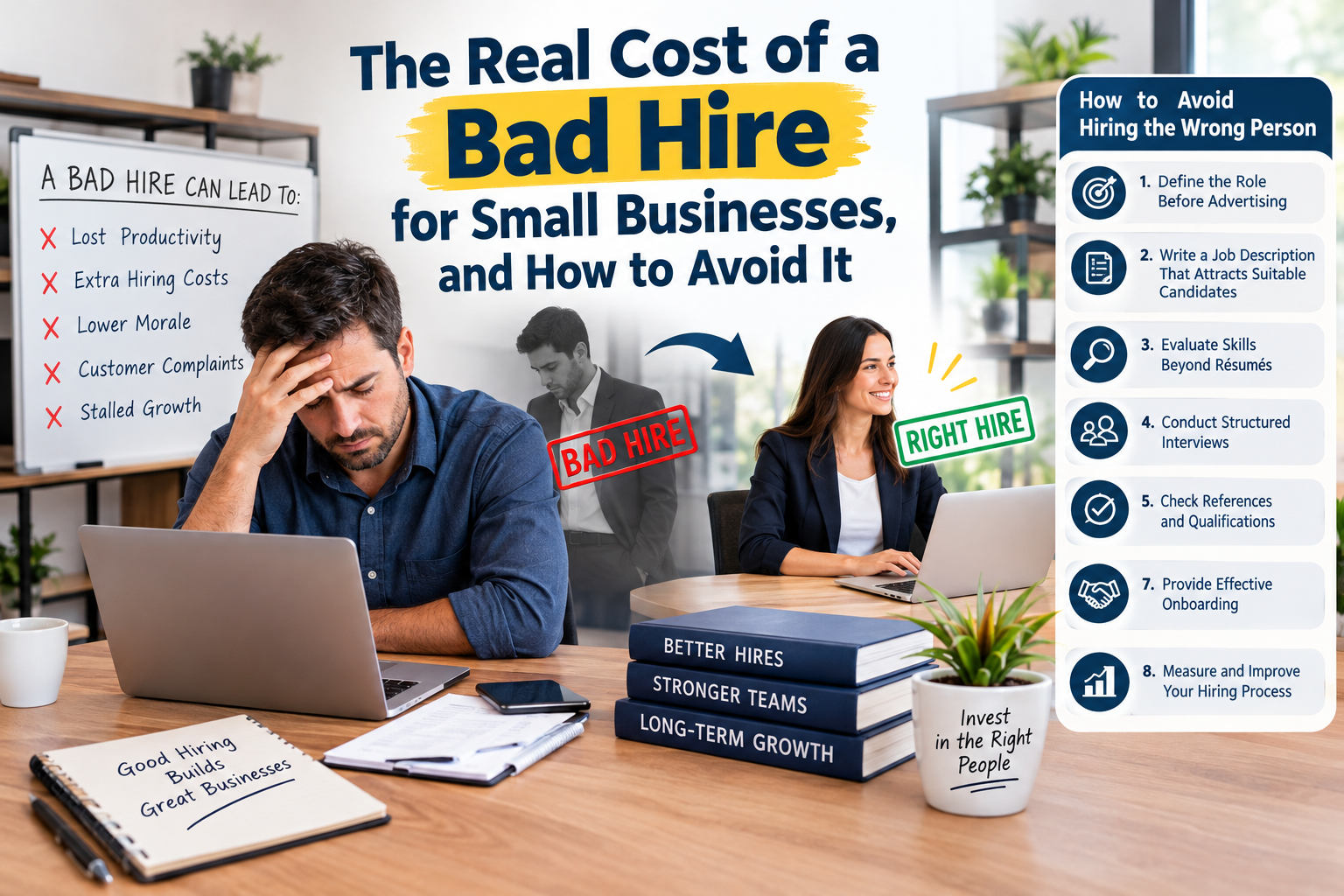
Hiring the right employees is essential for small business success. The right person can improve productivity, strengthen customer relationships, and help a company achieve its long-term goals. However, hiring someone who is not suitable for the role can create financial pressure, disrupt daily operations, and affect the performance of an entire team.
For small businesses, these challenges can be particularly difficult because budgets are often limited and employees handle multiple responsibilities. A poor hiring decision may lead to additional recruitment expenses, wasted training time, lower morale, and dissatisfied customers. Understanding these hidden costs can help business owners develop a more effective hiring strategy and avoid preventable mistakes.
Understanding the True Cost of a Bad Hire
The cost of an unsuccessful hire goes beyond the salary paid to an employee. Businesses invest time and resources in advertising vacancies, reviewing applications, interviewing candidates, checking qualifications, and providing training. When an employee cannot meet expectations or leaves shortly after joining, much of that investment may need to be repeated.
Managers also spend valuable time supervising new employees and correcting mistakes. For a small business owner, these responsibilities can take attention away from important activities such as serving customers, managing finances, developing products, and generating revenue.
There may also be indirect costs. Other employees might need to cover unfinished work, customers may experience delays, and important projects could fall behind schedule. Although these consequences do not always appear as separate expenses in financial records, they can affect overall business performance.
The actual cost depends on the position, the nature of the work, and how long the hiring problem continues. Recognizing these different expenses is the first step toward making better recruitment decisions.
See also: How Technology Is Changing Modern Education
Hidden Expenses Small Businesses Should Consider
Lost Productivity
An employee who lacks the necessary skills or understanding of the role may struggle to complete tasks efficiently. Mistakes, missed deadlines, and repeated requests for assistance can slow down operations.
In a small organization, every team member often plays an important role. When one employee performs below expectations, colleagues may need to complete additional work, creating pressure across the team.
Repeated Recruitment and Training
When a new hire does not work out, the business may need to advertise the position again, screen new applications, conduct interviews, and train another employee.
This process consumes both money and management time. Even if the company already has recruitment procedures in place, replacing an employee can delay other business priorities and create uncertainty for the remaining team.
Reduced Employee Morale
A poor hiring decision can affect employees who were already performing well. Team members may become frustrated when they repeatedly correct mistakes, cover missed responsibilities, or spend additional time helping an unsuitable colleague.
Over time, this extra pressure can reduce motivation and workplace satisfaction. If the situation is not addressed, productive employees may also begin considering other employment opportunities.
Customer Service Problems
Employees influence how customers perceive a business. Poor communication, unreliable service, and repeated errors can damage customer confidence.
For small businesses that depend on repeat customers and referrals, maintaining service quality is especially important. Resolving complaints and rebuilding relationships can require additional time and resources, while negative experiences may discourage future purchases.
How to Avoid Hiring the Wrong Person
Preventing every hiring mistake is impossible, but employers can reduce the risk by establishing a clear and consistent recruitment process.
1. Define the Role Before Advertising
A successful recruitment process begins with understanding what the business actually needs. Employers should identify the position’s main responsibilities, essential qualifications, required skills, and expected outcomes.
A vague job description can attract applicants who misunderstand the position or do not have the necessary experience. Conversely, an unnecessarily demanding description may discourage capable candidates who could perform well with appropriate training.
Business owners should focus on the skills and responsibilities that genuinely matter rather than including requirements simply because they appear in similar job advertisements.
When developing recruitment criteria, employers may seek relevant guidance from professionals such as Amy Cuilla, SHRM-SCP to help them think carefully about their hiring requirements and workforce needs.
A clear understanding of the role makes it easier to evaluate applicants fairly and identify candidates who are likely to contribute to the organization.
2. Write a Job Description That Attracts Suitable Candidates
A well-written job description communicates what the employer expects and what the candidate can expect in return. It should explain the position’s responsibilities, required experience, working arrangements, and opportunities for development where applicable.
Employers should also use straightforward language and avoid unnecessary jargon. Candidates are more likely to understand the opportunity when the description reflects the actual work rather than an unrealistic list of qualifications.
Small business owners should write a job description that attracts the right people by highlighting essential responsibilities, relevant skills, workplace expectations, and the qualities needed to succeed in the role.
This approach helps applicants assess whether the position matches their experience and interests before applying. It also gives hiring managers a clearer foundation for comparing candidates throughout the selection process.
3. Evaluate Skills Instead of Relying Only on Résumés
A résumé can provide useful information about a candidate’s experience, education, and employment history, but it does not always demonstrate how effectively someone will perform in a particular role.
Employers should consider practical assessments or work-related questions where appropriate. For example, a customer service candidate could explain how they would respond to a difficult complaint, while an administrative applicant might describe how they prioritize competing deadlines.
These assessments should reflect actual job responsibilities and be applied consistently to candidates being considered for the same position.
4. Conduct Structured Interviews
Unstructured interviews can encourage decisions based on personal impressions rather than relevant evidence. A structured interview gives each candidate a consistent opportunity to demonstrate their abilities.
Hiring managers should prepare questions about relevant experience, problem-solving, communication, and professional judgment. Asking candidates to describe how they handled specific workplace situations can reveal how they approach challenges.
Employers should evaluate responses against predetermined criteria instead of relying exclusively on whether they personally like a candidate.
5. Check References and Relevant Qualifications
Reference checks can help employers verify employment history, responsibilities, and professional experience. Depending on the position, it may also be appropriate to confirm licenses, certifications, or other qualifications.
These checks should follow applicable laws and privacy requirements. Employers should focus on information relevant to the role and avoid making assumptions based on incomplete details.
Reference checks are most useful when combined with interviews, skills assessments, and a clear understanding of the position’s requirements.
The Importance of Effective Onboarding
Recruitment does not end when a candidate accepts an offer. Even a capable employee may struggle if expectations are unclear or training is inadequate.
A structured onboarding process should introduce the employee to company policies, workplace procedures, key colleagues, and performance expectations. Employees should also receive the tools and information necessary to complete their responsibilities.
Regular conversations between managers and new employees can help identify questions, training needs, and potential problems early. Constructive feedback gives employees an opportunity to improve before small misunderstandings become ongoing performance issues.
For small businesses, effective onboarding can make the transition smoother and help new hires become productive members of the team.
Measure and Improve Your Hiring Process
Business owners should periodically review their recruitment practices to understand what is working and where improvements are needed.
Useful indicators include employee retention, time spent filling vacancies, training requirements, performance during the initial employment period, and recurring reasons for employee departures.
Employers can also gather feedback from hiring managers about whether new employees meet the expectations established during recruitment.
Reviewing this information can reveal whether job descriptions are unclear, interviews need improvement, or onboarding procedures require additional attention. The objective is to identify practical changes that improve future hiring decisions.
Conclusion
A bad hire can create financial and operational challenges that extend well beyond recruitment expenses. Lost productivity, repeated training, lower employee morale, and customer service problems can all affect a small business’s ability to grow.
Fortunately, employers can reduce these risks by defining positions clearly, attracting suitable applicants, evaluating skills carefully, conducting structured interviews, and providing effective onboarding.
The most successful hiring decisions begin with a realistic understanding of business needs and a consistent process for identifying the right candidates. By treating recruitment as a strategic investment, small businesses can make better use of their resources, build stronger teams, and create a more reliable foundation for long-term growth.
