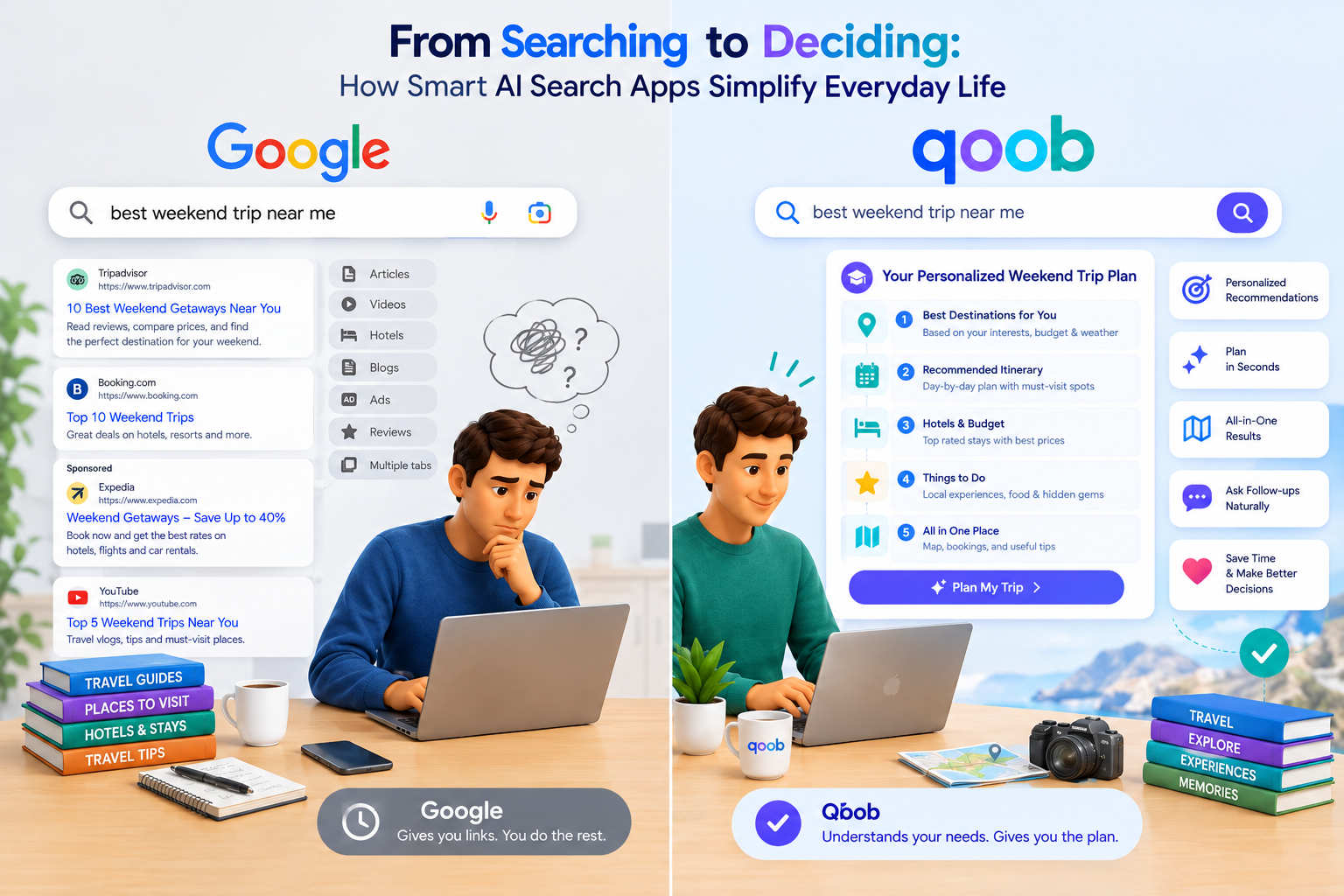
The way people search for information is changing. Traditional search engines can provide thousands of results, while general AI tools can produce lengthy responses. Both can be useful, but everyday questions often require something much simpler: a clear answer that helps you decide what to do next.
This is where a smart AI search app can make a difference. Instead of making users browse through multiple websites or learn complicated prompting techniques, modern AI search platforms are designed to understand questions in natural language and provide concise, useful answers.
The goal is not simply to search for more information. It is to move from searching to deciding with less effort.
For a simpler way to find relevant answers and make everyday decisions, explore this smart AI search app and see how a more personal search experience can fit into your daily routine.
What Is a Smart AI Search App?
A smart AI search app combines search technology with artificial intelligence to help users find relevant information more efficiently. Rather than simply presenting a list of websites, it can understand the intent behind a question and provide a direct response.
For everyday users, this can make searching feel more natural. You can ask a question in the same way you would ask another person instead of trying to identify the perfect keywords.
How Smart AI Search Works
AI search uses technologies that can understand language, context and the purpose behind a query.
A typical experience may involve:
- Understanding the meaning behind your question
- Finding relevant information
- Processing and organising that information
- Presenting the result in a concise format
The exact technology differs between platforms, but the objective is generally to reduce the work required from the user.
Why Traditional Search Can Feel Time Consuming
Traditional search engines are excellent for discovering websites, resources and information. However, finding an answer can sometimes require several additional steps.
You may need to open different pages, compare information, ignore advertisements, check whether the information is relevant and then decide which option makes the most sense.
For a large research project, this process may be worthwhile. For simple daily questions, it can feel unnecessarily complicated.
The Problem With Too Many Results
Having more information does not always make a decision easier.
When a search produces dozens of results, users still have to determine which information matters. This creates additional work between asking a question and taking action.
A smart AI search experience aims to reduce this gap by organising useful information around the question itself.
From Search Results to Useful Answers
One of the biggest changes introduced by AI search is the shift from links to answers.
Instead of asking users to visit multiple websites before understanding a topic, AI search can summarise relevant information and present it in a more accessible way.
Qoob describes its approach as providing short, clear answers designed to help with everyday decisions rather than simply returning a list of links.
This can be particularly useful when the question has a practical goal.
Questions That Need a Decision
Everyday life is full of questions that lead directly to decisions.
For example:
- Where should I go this weekend?
- What can I cook with the ingredients I have?
- Which product is more suitable for my needs?
- What should I consider before choosing an option?
- How can I plan this task more efficiently?
These questions do not necessarily require hours of research. They require relevant information presented in a way that is easy to understand.
How AI Search Can Simplify Everyday Decisions
A smart AI search app can support many small decisions throughout the day.
The value is not necessarily in solving one complicated problem. It can come from making dozens of small tasks easier.
Travel Planning
Planning a trip often involves checking destinations, activities, weather, transport, opening hours and other practical details.
Instead of searching for each detail separately, users can ask more complete questions and get information that relates directly to their situation.
This can help turn a broad travel idea into a clearer plan.
Shopping and Comparisons
Online shopping can involve comparing specifications, prices, features and reviews across multiple websites.
AI search can help users organise the information they need before making a purchase decision. The user can ask what the important differences are and focus on the factors that matter most to them.
The final decision still belongs to the user, but the research process can become more manageable.
Food and Recipe Ideas
Another simple example is deciding what to cook.
Instead of searching for recipes individually, a user can describe what ingredients they have, what type of meal they want and any preferences they have.
A personalised search experience can then help narrow down the possibilities.
Personalisation Makes Search More Relevant
Not every user wants the same answer.
Two people can ask exactly the same question but have completely different requirements. One person may care about price, another about convenience, while another may prioritise quality or time.
Personalised AI search aims to take this context into account.
Qoob says its search experience uses context and user preferences to make answers more relevant to the individual rather than treating every query as completely generic.
Why Context Matters
Imagine asking, “Where should I go this weekend?”
A generic response could provide a long list of popular destinations. A more contextual answer could take factors such as your interests, available time and preferences into account.
The second approach is closer to the actual decision you are trying to make.
Natural Language Makes AI Search Easier
One of the advantages of AI search is the ability to ask questions using ordinary language.
You do not necessarily need to understand search operators, technical commands or complex prompting methods.
You can explain what you want in your own words.
Ask Questions Naturally
For example, instead of searching:
“best restaurants weekend family budget”
you could ask:
“Where can I take my family for a reasonably priced meal this weekend?”
The second version gives more context about the intention behind the search.
Modern AI search systems are designed to understand this type of conversational query.
Smart AI Search and Time Saving
Time is one of the biggest reasons people look for better search experiences.
Even a few minutes saved on individual searches can add up when similar searches are made throughout the day.
Qoob positions its smart search experience around reducing unnecessary browsing and helping users reach useful answers more quickly.
Less Browsing, More Doing
A streamlined search process can reduce the number of tabs users need to open.
Instead of moving between different websites to build an answer themselves, users can start with a concise response and then explore further when necessary.
This is especially useful for simple questions where the goal is to make a quick decision rather than conduct extensive research.
Smart AI Search vs General AI Chatbots
AI search apps and general AI chatbots can appear similar because both can respond to natural language questions.
However, their primary purposes can be different.
A general AI chatbot may focus on conversation, writing, brainstorming and content generation. A smart AI search app can focus more specifically on finding relevant information and helping users make everyday decisions.
Qoob describes itself as a personal AI search app rather than a general-purpose chatbot, with its experience centred on search and decision making.
Choosing the Right Tool
The best tool depends on what you are trying to accomplish.
If you need to write content, brainstorm ideas or have a long conversation, a general AI assistant may be appropriate.
If you want a direct answer to an everyday question and need help narrowing down a choice, an AI search experience may be more suitable.
Privacy and User Control Matter
As AI becomes more integrated into search, privacy has become an important consideration.
Users may share preferences, questions and personal context when interacting with an AI-powered search system. Understanding how that information is handled is therefore important.
Qoob states that users control what context it remembers and says it does not sell usage data. These are claims made by the company, so users should review the platform’s own privacy information when evaluating the service.
What Users Should Consider
Before choosing an AI search platform, consider:
- What information does the service collect?
- Does it remember search context?
- Can users control or delete stored information?
- How is personal information used?
Understanding these points can help users make informed choices about the tools they use.
What the Future of AI Search Could Look Like
Search is increasingly moving beyond simple keyword matching.
The focus is shifting toward understanding intent, context and the practical outcome behind a question.
Instead of asking users to search repeatedly, compare pages and reach their own conclusion, AI-powered search can help bring relevant information together.
The result is a more decision-oriented approach to finding information.
From Information to Action
The future of search may not simply be about providing more information.
It can be about providing the right information in a format that helps people act.
Whether someone is choosing a restaurant, planning a trip, comparing products or deciding what to cook, the useful outcome is often the same: understand the options and move forward.
How Qoob Fits Into Smarter Everyday Search
Qoob is built around the idea of smart search for everyday decisions. Its platform focuses on short answers, personal context and helping users move from a question to a decision without unnecessary browsing.
Rather than requiring users to learn complex AI prompting, Qoob says users can ask questions naturally and receive concise answers designed around practical decisions.
For people who regularly search for small everyday questions, this approach can make the search process feel simpler and more focused.
Final Thoughts
A smart AI search app represents a shift in how people interact with information.
Traditional search is largely built around discovering links, while AI search can bring information together and present it in a more direct format.
The biggest benefit may be the reduction of friction between having a question and making a decision. Whether you are planning a trip, comparing products, finding a recipe or simply trying to understand something quickly, a more personalised search experience can make everyday tasks easier.
The future of search is not necessarily about searching more. It is about finding relevant information faster, understanding it clearly and having enough context to decide what to do next.
Qoob is a smart search app designed to provide clear, personalised answers that help make everyday decisions simpler.
