Moisture control is an important part of many industrial processes where materials, products, equipment, or production conditions are sensitive to humidity. Conventional air-conditioning systems can control temperature effectively, but applications requiring very dry air often need dedicated dehumidification technology.
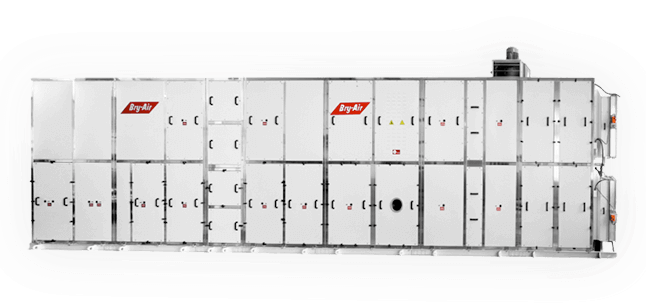
A low dew point dehumidifier is designed to remove moisture from process air and maintain controlled dew point conditions. Bry-Air’s Low Dew Point Dehumidifiers are engineered to achieve supply air dew points from approximately -40°C to -80°C, depending on system configuration and application requirements.
Precise moisture control becomes particularly important when production involves hygroscopic materials or processes where even small amounts of moisture can affect product quality, performance, safety, or process stability.
What Does Dew Point Tell Manufacturers?
Dew point represents the temperature at which air reaches saturation and moisture begins to condense. A lower dew point indicates that the air contains less moisture.
For industrial applications, monitoring and controlling dew point can therefore provide a more meaningful indication of actual moisture conditions than relying only on relative humidity. As temperature changes, relative humidity can fluctuate even when the actual moisture content remains similar.
A properly designed desiccant dehumidification system continuously removes moisture from the air, helping maintain the target environmental conditions required by the process.
How Does a Low Dew Point Dehumidifier Work?
Low dew point dehumidification generally relies on desiccant technology. In a desiccant system, humid process air passes through a moisture-adsorbing desiccant medium. The desiccant captures water vapour from the air, allowing the treated air to leave the system with a significantly lower moisture content.
The desiccant material eventually accumulates moisture and must be regenerated. A separate regeneration airflow removes the collected moisture from the desiccant so that the drying cycle can continue. This continuous adsorption and regeneration process allows industrial dehumidifiers to operate consistently for demanding moisture-control applications.
Why Is Desiccant Technology Suitable for Ultra-Dry Applications?
Desiccant dehumidification can achieve moisture levels that are difficult to maintain with conventional refrigeration-based systems alone. This makes the technology useful for applications where extremely low dew points are required.
Bry-Air states that its LDP systems use high-performance desiccant rotors and patented technologies designed for demanding low humidity environments. The company also provides customized systems based on airflow, target dew point, room conditions, and process requirements.
Which Industries Need Very Low Dew Point Conditions?
The need for low dew point air varies according to the material and manufacturing process. Industries handling moisture-sensitive products can require tightly controlled environmental conditions to maintain consistency and protect product performance.
Lithium-ion battery manufacturing is one of the most demanding applications. Battery materials can be highly sensitive to moisture, making dry rooms an essential part of several production stages. Bry-Air identifies low humidity control as a critical requirement for lithium battery manufacturing and states that its systems can support extremely low dew point conditions.
Are Low Dew Point Systems Used Outside Battery Manufacturing?
Yes. Low moisture environments can also be required in pharmaceutical manufacturing, medical device production, specialized material processing, safety glass applications, and other moisture-sensitive industrial processes.
The exact humidity and dew point requirement depends on the process. A system should therefore be selected according to the actual moisture load, operating temperature, airflow, room volume, material characteristics, and required environmental specifications rather than using a standard humidity target for every application.
How Can a Low Humidity Room Support Process Stability?
A controlled low humidity room provides a defined environment where moisture levels can be maintained within the limits required by the manufacturing process.
For sensitive production areas, controlling room humidity is not simply about making the air feel dry. It involves controlling moisture infiltration, air leakage, ventilation, temperature, airflow, and the moisture generated or introduced by the production process.
What Happens When Humidity Is Not Properly Controlled?
Uncontrolled moisture can contribute to material degradation, condensation, inconsistent processing conditions, and reduced product performance. In battery manufacturing, for instance, moisture exposure can negatively affect battery performance and product life.
In pharmaceutical and cleanroom environments, excessive humidity can also contribute to moisture absorption by powders and create process-control challenges. Bry-Air notes that humidity control is important in several pharmaceutical applications where moisture can affect powder handling and manufacturing consistency.
What Should Manufacturers Consider When Selecting a Low Dew Point Dehumidifier?
Selecting the right system requires more than comparing the lowest achievable dew point. The dehumidifier should be engineered around the complete environmental and process requirements.
Important considerations include the required supply air dew point, airflow capacity, room dimensions, ambient conditions, fresh air quantity, heat load, moisture load, operating temperature, pressure requirements, and desired control strategy.
Why Is Energy Efficiency Important?
Dehumidification can represent a significant portion of the energy consumption in highly controlled environments, particularly in large dry rooms. Therefore, energy efficiency should be considered alongside moisture removal performance.
Bry-Air states that its Low Dew Point systems are designed with energy-efficient technologies and reports potential energy consumption reductions of 30% to 60%, depending on system design and application conditions.
The actual energy performance of any installation depends on operating conditions, airflow, regeneration requirements, ambient moisture load, and system configuration. Proper engineering is therefore essential for achieving the expected efficiency.
How Can Advanced Dehumidification Improve Dry Room Performance?
A well-engineered dry room requires more than a dehumidifier alone. The room envelope, insulation, vapour-tight construction, airlocks, ductwork, controls, sensors, and airflow arrangement all influence the ability to maintain low moisture conditions.
Bry-Air’s LDP systems can be integrated with dedicated dry room infrastructure, including insulated panels, vapour-tight construction, airlocks, duct insulation, dew point sensors, and PLC-based controls.
Why Does System Integration Matter?
Even a high-performance dehumidifier can struggle to maintain a target dew point if moisture continuously enters through leaks, poorly sealed doors, unsuitable materials, or excessive uncontrolled fresh air.
A complete system approach allows engineers to evaluate the dehumidifier, room construction, air distribution, and process conditions together. This can provide better control and help maintain stable environmental conditions throughout production.
How Does Bry-Air Approach Low Dew Point Dehumidification?
Bry-Air has developed specialized dehumidification systems for applications requiring very low moisture levels. Its LDP range is designed around customized environmental control requirements and includes technologies intended for demanding dry room applications.
The company states that its systems can deliver supply air dew points ranging from -40°C to -80°C and are designed particularly for lithium-ion battery manufacturing and other hygroscopic material processing applications.
Bry-Air also highlights its dedicated testing and manufacturing capabilities for low dew point applications, including a working dry room and testing facilities for evaluating system configurations.
What Is the Best Way to Maintain Consistent Low Moisture Conditions?
Consistent performance begins with defining the required process conditions accurately. Manufacturers should establish the target dew point, room temperature, airflow, moisture load, fresh air requirements, and operating schedule before selecting equipment.
Regular monitoring is equally important. Dew point sensors and automated controls can help operators identify changes in environmental conditions and maintain the required operating range.
Preventive maintenance should also cover desiccant components, filters, seals, ductwork, sensors, controls, and other system components. A well-maintained system can provide more reliable moisture control over its operating life.
Conclusion
A low dew point dehumidifier can play a critical role in industrial environments where ordinary humidity control is not sufficient. By continuously removing moisture and maintaining very low dew point conditions, desiccant-based systems can support moisture-sensitive manufacturing processes and controlled dry rooms.
The right solution depends on the specific process, room conditions, airflow requirements, moisture load, and target dew point. Bry-Air’s Low Dew Point Dehumidifiers are engineered for demanding applications, with configurations capable of achieving supply air dew points between -40°C and -80°C.
For manufacturers evaluating a new dry room or upgrading an existing moisture-control system, a detailed engineering assessment is essential. To discuss application requirements and system options, visit Contact Us.
