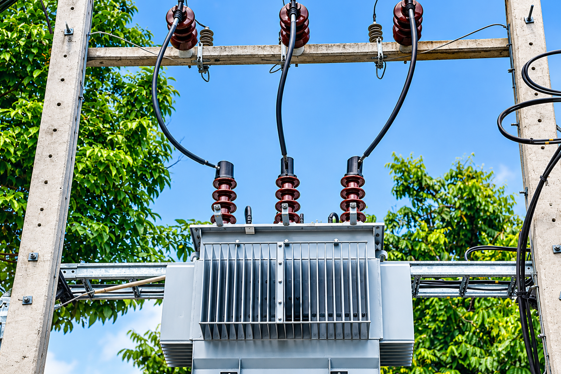
A transformer rated at 50 kVA is commonly used to supply electrical power to small commercial buildings, workshops, agricultural facilities, and light industrial installations. Choosing the right unit requires more than checking its capacity. Buyers also need to consider voltage requirements, phase configuration, insulation, cooling method, installation environment, and applicable electrical standards.
This guide explains how a 50 kVA three-phase transformer works, which specifications deserve attention, what affects its price, and how to select a suitable model for a particular application.
What Is a 50 kVA 3 Phase Transformer?
A 50 KVA 3 phase transformer is an electrical device that transfers power between circuits through electromagnetic induction while changing voltage levels. Its rated capacity is 50 kilovolt-amperes (kVA), which represents apparent power rather than real power measured in kilowatts (kW).
Three-phase transformers are widely used in electrical distribution systems because they can supply balanced three-phase loads, including motors, pumps, compressors, and industrial machinery. They may also serve suitable single-phase loads when the winding configuration and installation design permit it.
The actual usable power depends on the connected load’s power factor. For example, at a power factor of 0.8, a fully loaded 50 kVA unit supplies approximately 40 kW of real power.
See also: How Home Builders Port Macquarie Bring Your Building Plans to Life
Common Applications and Installation Types
A transformer of this capacity can support several types of installations, provided the calculated demand remains within its rated capacity.
Typical applications include:
- Commercial properties: Small offices, retail premises, and other buildings requiring dedicated electrical distribution.
- Workshops: Equipment such as small machine tools, compressors, and fabrication machinery.
- Agricultural facilities: Irrigation pumps, farm buildings, and selected processing equipment.
- Light industrial sites: Production equipment, control systems, and auxiliary electrical loads.
- Utility distribution: Local distribution networks where the required capacity and voltage ratings match the installation.
The choice between an indoor, outdoor, pole-mounted, or ground-mounted unit depends on site conditions, utility requirements, access, and safety clearances.
50 kVA Transformer Specifications to Check
The correct technical ratings depend on the electrical system where the transformer will operate. Buyers should review the manufacturer’s nameplate and technical datasheet instead of assuming every unit has identical specifications.
Important parameters include:
1. Rated capacity: The transformer must supply the expected demand without exceeding its thermal limits. Engineers should account for starting currents, future expansion, and load diversity.
2. Primary and secondary voltage: Common distribution arrangements include medium-voltage primary connections and low-voltage secondary outputs. The exact ratings must match the supply network and connected equipment.
3. Frequency: The unit must be designed for the system frequency, typically 50 Hz or 60 Hz, as specified by the installation.
4. Winding configuration: Three-phase transformers may use star and delta connections in different combinations. The selected arrangement determines the available voltage relationships, neutral availability, and phase displacement.
5. Cooling and insulation: Liquid-immersed and dry-type designs use different cooling and insulation systems. Selection depends on environmental conditions, fire protection requirements, maintenance practices, and installation location.
6. Efficiency and losses: Core losses occur whenever the transformer is energized, while winding losses generally increase with load. Comparing these figures helps estimate operating costs over the equipment’s service life.
7. Impedance and temperature rise: These characteristics affect fault current, voltage regulation, and thermal performance. They should comply with the requirements of the electrical system.
How to Estimate the Current Rating
Calculating the rated current helps engineers verify whether cables, protective devices, and connected equipment are appropriately sized.
For a balanced three-phase system, the line current is calculated using:
Current (A) = kVA × 1,000 ÷ (√3 × line voltage)
For a 50 kVA transformer with a 415 V secondary supply:
Current = 50,000 ÷ (1.732 × 415)
The rated secondary line current is approximately 69.6 A.
At a primary voltage of 11 kV, the corresponding rated primary current is approximately 2.62 A. These values are illustrative and assume the stated voltages are the transformer line-to-line ratings.
Actual cable sizes and protective-device ratings require additional engineering checks, including installation conditions, short-circuit withstand capability, ambient temperature, and applicable electrical regulations.
Understanding the 50 kVA Transformer Price
The 50 KVA transformer price varies according to the design, electrical ratings, manufacturing quality, and installation requirements. A basic distribution transformer may cost substantially less than a specially configured model intended for demanding environmental or industrial conditions.
Several factors influence the purchase cost:
- Transformer type: Dry-type, oil-immersed, and pad-mounted designs have different construction and installation requirements.
- Voltage ratings: Higher primary voltage ratings can require additional insulation and specialized components.
- Efficiency class: Designs with lower losses may have a higher initial purchase price but reduce electricity losses over time.
- Accessories: Bushings, tap changers, protective devices, monitoring equipment, and enclosures affect the final quotation.
- Standards and testing: Required certifications, routine tests, and specialized inspections may influence manufacturing costs.
- Transportation and installation: Delivery, lifting equipment, civil works, earthing, commissioning, and electrical connections may be charged separately.
For an accurate comparison, request itemized quotations from multiple manufacturers. Confirm the rated voltages, winding connections, losses, warranty, testing documentation, delivery charges, and installation scope. Prices should be compared on the same technical basis rather than by capacity alone.
When Is a 50 kVA Pad Mounted Transformer Suitable?
A 50 KVA pad mounted transformer is designed for ground-level installation, usually inside a secure, weather-resistant enclosure. It is commonly considered for underground distribution systems serving commercial developments, residential areas, and selected industrial sites.
Compared with pole-mounted equipment, this arrangement can provide a more accessible installation point while keeping energized components enclosed. Its suitability depends on the available space, required electrical clearances, ventilation, access for maintenance, and protection against unauthorized entry.
Before selecting a ground-mounted unit, confirm that its enclosure and insulation system suit the installation environment. Outdoor sites may require protection against moisture, corrosion, flooding, and extreme temperatures. The foundation, cable-entry arrangement, earthing system, and access clearances must also meet the manufacturer’s instructions and local electrical requirements.
A pad-mounted design is not automatically the best choice for every site. Indoor facilities may benefit from dry-type equipment, while other distribution networks may require different mounting arrangements.
How to Select the Right Transformer
Selecting a transformer 50 KVA requires a review of the actual load profile, electrical supply, installation conditions, and expected operating life.
Start by calculating the total demand of the connected equipment. Include motor starting requirements, simultaneous operation, power factor, and reasonable provision for future loads. Oversizing without a clear reason can increase capital cost and no-load losses, while undersizing can cause overheating, voltage problems, and premature equipment failure.
Next, confirm the primary and secondary voltages, frequency, phase configuration, neutral requirements, and impedance. Check the installation environment and determine whether an oil-immersed or dry-type design is appropriate.
Ask the supplier for a complete technical datasheet, guaranteed loss figures, routine test results, applicable standards, warranty conditions, and maintenance recommendations. Installation and commissioning should be handled by qualified electrical professionals in accordance with local regulations.
Final Considerations
A 50 kVA three-phase transformer can be a practical choice for modest commercial, agricultural, and industrial loads when its ratings match the electrical demand. Careful comparison of voltage specifications, efficiency, cooling, installation type, and total ownership cost helps buyers avoid unsuitable equipment.
Before placing an order, verify the load calculation, obtain a detailed quotation, and review the manufacturer’s documentation. A properly selected and installed transformer can provide dependable service while keeping electrical losses, maintenance needs, and avoidable operating costs under control.
